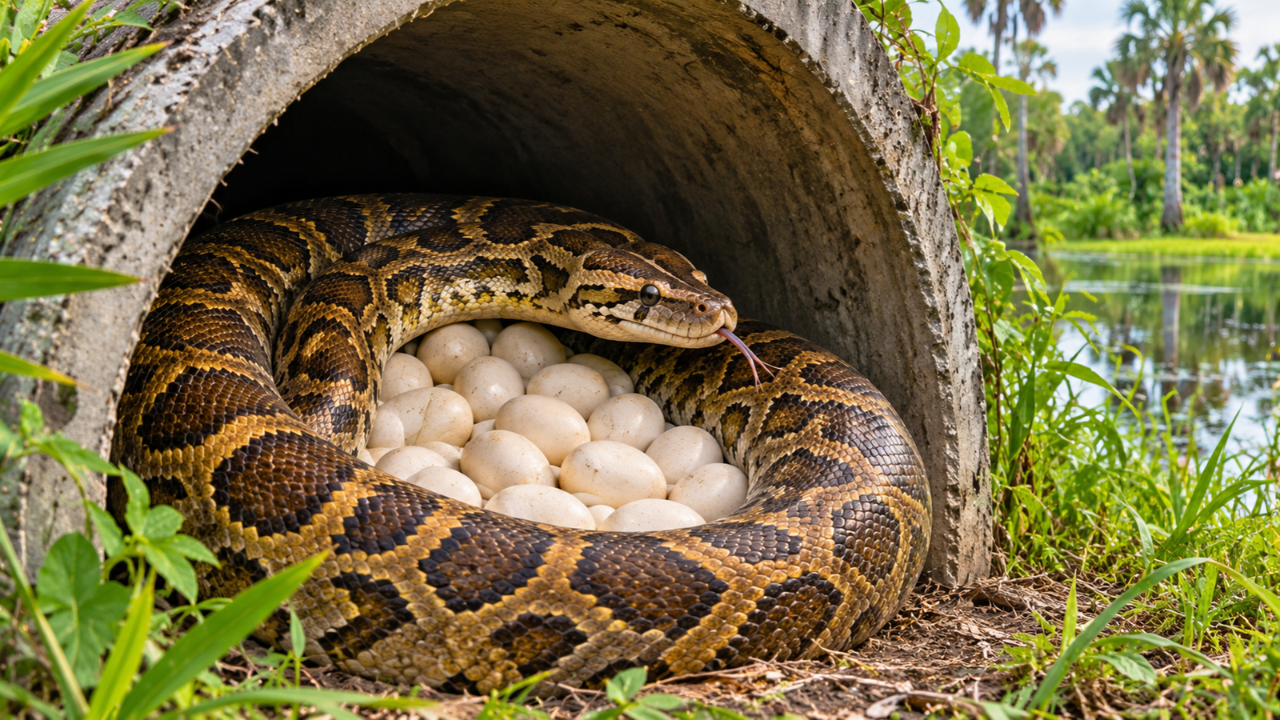
When a massive 73.6-kilogram female Burmese python slithered into an abandoned concrete drainage pipe in Florida's Big Cypress National Preserve, she wasn't just hiding. She was setting up a makeshift nursery that would soon challenge everything biologists thought they knew about invasive reptile reproduction in the Greater Everglades Ecosystem.
Researchers tracking wild pythons stumbled upon the nest after monitoring the 442-centimeter-long snake for months. Inside a six-meter-long concrete culvert pipe, she had deposited an astonishing 96 eggs. For context, the average wild clutch in Florida sits right around 49 eggs. This single female doubled the standard output, proving just how dangerously adaptable these apex predators have become in human-altered landscapes.
How a Concrete Pipe Became an Incubation Chamber
Most wild Burmese pythons stick to thick underbrush or decaying forest debris piles when they're ready to lay. Concrete storage yards and abandoned construction zones aren't exactly textbook wildlife habitats. Yet, wildlife cameras monitoring the site revealed that the rigid structure provided an unexpectedly stable microclimate for the massive clutch.
It wasn't just a matter of dropping eggs and walking away. Pythons don't abandon their young right away. They invest weeks of brutal physical effort into guarding and warming the site.
The Physics of Shivering Thermogenesis
Reptiles are cold-blooded, meaning they rely on external heat sources to regulate their body temperature. But brooding pythons have a trick up their scaly sleeves. They use a process called shivering thermogenesis.
By rapidly contracting their muscles, brooding females generate real metabolic heat. Temperature data loggers placed inside the concrete pipe caught the female maintaining incubation temperatures more than 5 degrees Celsius higher than the surrounding environment. While the outside air hovered around 27.7 degrees Celsius, her coiled mass kept the eggs sitting comfortably near 33 degrees Celsius.
Even curious Virginia opossums that wandered into the pipe quickly turned around and left once they realized an enraged, brooding python was occupying the space.
The Brutal Toll of Reproduction
Generating that much metabolic heat and producing 96 eggs doesn't come cheap. Before nesting, the female tipped the scales at 67.8 kilograms. Once the eggs hatched and she finally abandoned the nest in mid-July, her body mass had plummeted to 48.9 kilograms.
That is a staggering 27.9 percent drop in body weight from a single reproductive cycle. It explains why wild Burmese pythons typically reproduce only every two to three years. They basically push their bodies to the absolute brink just to give their offspring a fighting chance.
What This Means for Everglades Conservation
Out of the 96 eggs laid in that concrete pipe, 83 successfully hatched into a balanced split of 41 males and 41 females, with a few unrecorded or unhatched individuals. When those hatchlings dispersed into the Florida wetlands, they added dozens of new apex predators to an ecosystem that is already struggling under the weight of the invasion.
Wildlife management teams face an uphill battle against a species that can not only hide in plain sight but actively exploit human infrastructure to maximize breeding success. Every concrete pipe, abandoned culvert, and piece of discarded debris in the Everglades is a potential maternity ward. Understanding these behaviors is the only way researchers can hope to outsmart an adversary that treats the Florida wilderness like home.